
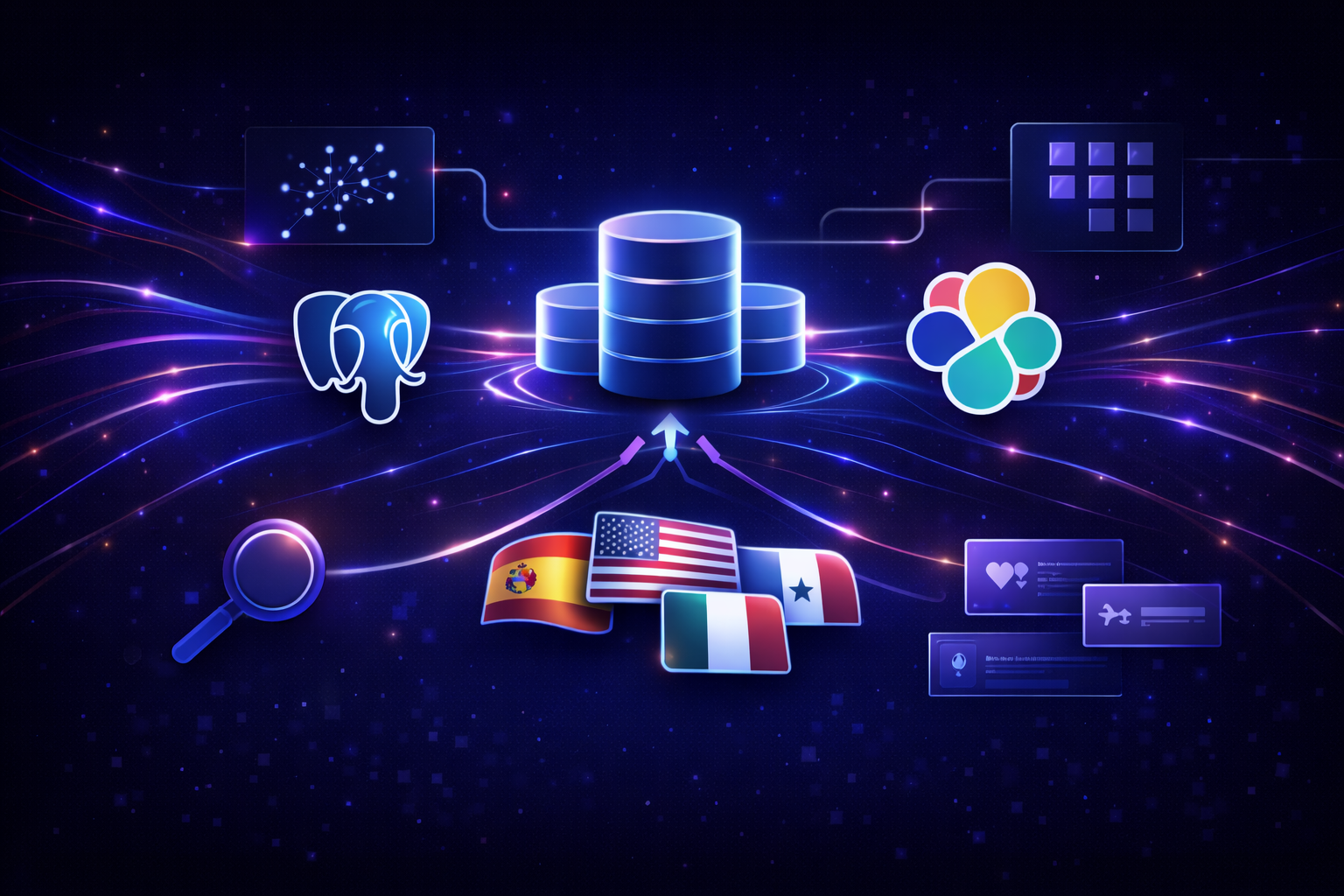
Hybrid AI Search with Elastic and Postgres: How Marketplaces Achieve Smarter, Faster, Multilingual Search
Learn how marketplaces combine Elastic, Postgres, and vector search to deliver fast, multilingual, and highly relevant results. A real-world guide to hybrid AI search architecture, performance tuning, and scaling from Hyperflex engineers.
1. Why Marketplaces Need Hybrid Search
Modern marketplaces blend structured and unstructured data: product listings, scraped feeds, user-generated content, and external APIs.
A single search engine whether relational or semantic cannot handle this diversity effectively.
Common Founder Problems
- Latency grows as listings scale beyond a few hundred thousand.
- Keyword search alone misses semantic intent (“cheap blue car” vs. “auto azul barato”).
- Deduplication across sources becomes painful.
- Vector indexes drift and relevance drops without retraining.
A hybrid AI search solves these problems by combining Postgres for relational accuracy and Elastic for semantic, multilingual intelligence, with vector embeddings layered for meaning.
2. The Role of Postgres and Elastic Together
Hybrid architectures don’t replace one technology with another; they align strengths.
This layered approach allows Postgres to maintain integrity while Elastic provides speed and search intelligence.
3. Architecture Deep Dive: Vector + Keyword + Fallback
A high-performance hybrid search includes three layers:
- Vector Search (Elastic / ELSER): Retrieves contextually similar results using embeddings.
- Keyword Search (Postgres Full-Text): Handles precision filters and exact matches.
- Fallback Logic: Ensures users always see relevant data even if embeddings fail.
Example Flow
// Hybrid search flow example
vector_results = elastic.search(embedding_query)
keyword_results = postgres.fulltext_search(keyword_query)
final_results = rerank(vector_results + keyword_results)
return deduplicate(final_results)
This logic guarantees the “no empty results” principle which is vital for marketplaces.
Hyperflex often integrates Redis caching for recent popular queries and async rerankers powered by OpenAI embeddings for improved semantic precision.
“Hybrid AI search isn’t a rebuild, it’s an upgrade to intelligence.”
4. Multilingual and Semantic Relevance
Marketplaces in Latin America, Europe, and Asia face multilingual query challenges.
Elastic’s analyzers make cross-language retrieval simple and efficient.
Example Analyzer Mapping
By using language analyzers, phonetic filters, and custom synonym dictionaries, Elastic resolves both language mismatch and spelling variance (e.g., “auto azul barato” → “cheap blue car”).
Hyperflex also deploys Elastic’s Learned Sparse Encoder (ELSER) for semantic understanding, achieving up to 95% multilingual recall accuracy across hybrid datasets.
5. Performance KPIs That Matter
Performance is measurable. Hyperflex’s Elasticsearch Consulting Services consistently deliver tangible improvements.
Such improvements come from:
- Index analyzer tuning
- Query normalization pipelines
- Smart caching (Redis + Elastic)
- Continuous embedding refreshes
For deeper technical insight, see Elastic Vector Search documentation.
6. Monitoring, Debugging, and Reliability
Hyperflex engineers emphasize search reliability as a first-class metric.
We implement:
- Kibana dashboards for latency, recall, and dedup KPIs.
- Structured logging for anomaly detection in query flow.
- Query benchmarking frameworks to compare vector and keyword precision.
Example debug insight:
# sample log output
Query ID: 28419
Vector latency: 41ms
Keyword latency: 32ms
Rerank latency: 12ms
Result count: 32
Duplicates removed: 5
These metrics ensure your hybrid system remains predictable under real-world load.
7. The Hyperflex Advantage
Hyperflex combines Elastic expertise with real production experience across search-driven platforms.
Hyperflex Advantage
• Certified Elastic Engineers with marketplace experience
• Proven latency reduction and multilingual tuning
• Dual-stack Postgres + Elastic integration expertise
• Continuous monitoring and vector lifecycle management
When a marketplace scales from thousands to millions of listings, this combination ensures that every search stays fast, accurate, and contextually intelligent.
8. Conclusion and Call to Action
Hybrid AI Search is no longer experimental, it’s the new baseline for intelligent marketplaces.
Postgres brings structure. Elastic adds meaning. Together, they deliver a search that feels human.
At Hyperflex, our Elasticsearch Consulting Services help teams evolve from prototype search to production-grade AI systems.
Whether your stack uses Elastic, Postgres, or a hybrid pipeline, we help you optimize for:
- Speed through index tuning and caching
- Accuracy with embeddings and rerankers
- Multilingual performance powered by Elastic analyzers
Hyperflex helps marketplaces search smarter across languages, at scale, and with confidence.

